Ten conflicting trials, one answer that settles it.
What it is
One question. All the evidence. One answer.
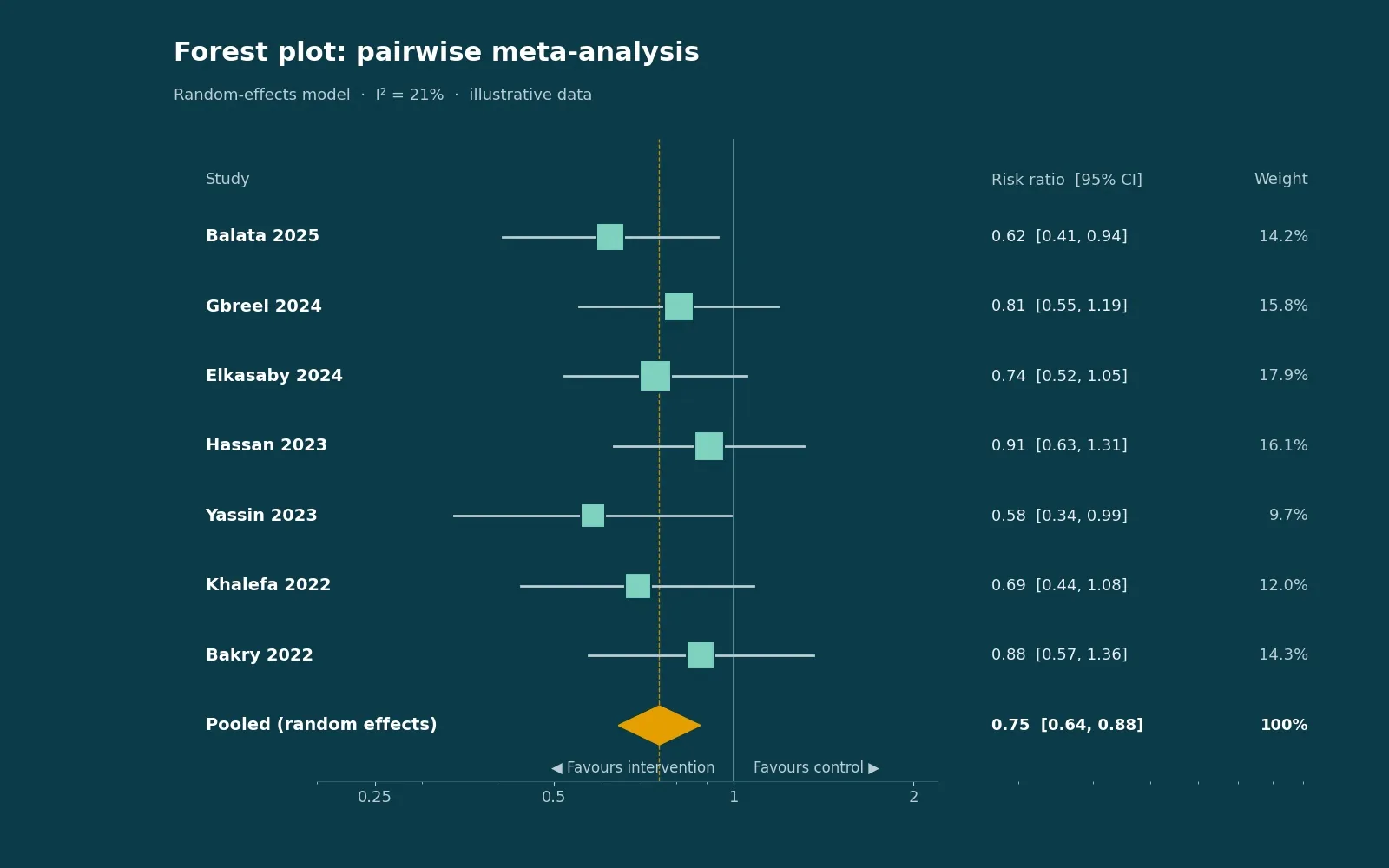
A systematic review finds every study that has asked your question. A meta-analysis then combines their results statistically, so instead of ten small, conflicting trials you have a single pooled estimate, with a confidence interval, a measure of how much the studies disagree, and an honest read on how much to trust it.
Three types we run
Pairwise, compares two options (A vs B) by pooling head-to-head studies.
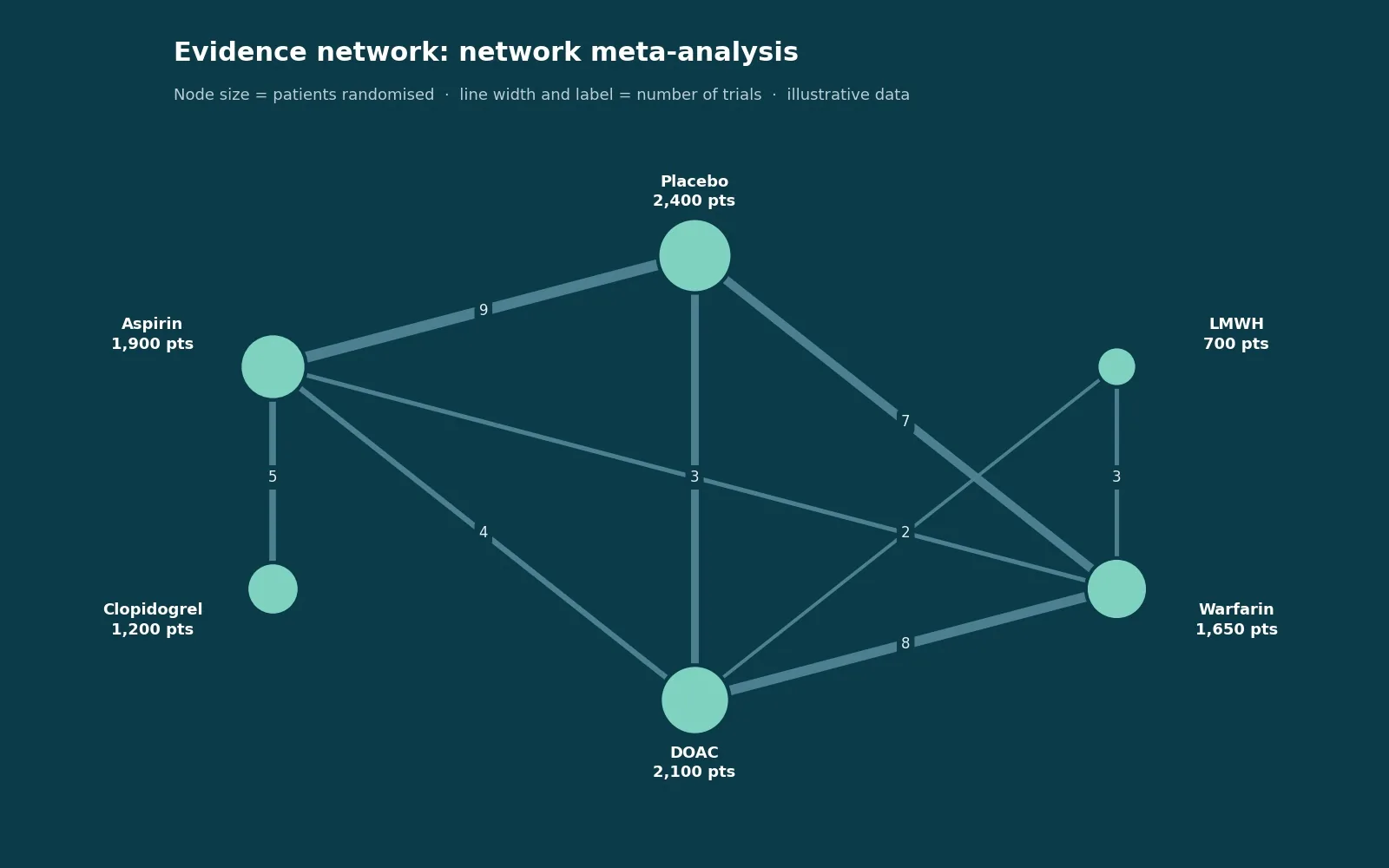
Network, compares many treatments at once, even those never tested directly against each other, and ranks them.
Individual-patient-data (IPD), pools the raw patient-level data (or reconstructs it from published survival curves) for the most powerful, flexible analysis.
Comparing many treatments, or pooling a diagnostic test? See network meta-analyses and diagnostic accuracy meta-analyses.
How it works
The method, in plain terms.
Protocol
PROSPERO, before results
Search
PubMed, Embase, Scopus
Screen & extract
Two reviewers
Risk of bias
RoB 2, ROBINS-I
Pool
Random effects, I²
Certainty
Subgroups, GRADE
How you benefit
Why authors start here.
- No patients, no waiting. No recruitment, no ethics bottleneck for data collection, no years of follow-up, a publishable study in months.
- High on the evidence ladder. A well-run meta-analysis is cited heavily and respected by promotion committees and editors alike.
- Defensible under review. Pre-registered, PRISMA-reported, and reproducible, so reviewers find rigor, not gaps.
- A platform for more. One strong review often seeds a whole line of related papers.
Scope the question
We refine your idea into a focused PICO question and check the literature is neither empty nor already saturated.
Protocol & PROSPERO
We write and register the protocol, locking the method before results are seen.
Search, screen, extract
We run the search and manage dual screening and data extraction, keeping a full audit trail.
Analysis
We pool the data in R or Stata, assess heterogeneity and bias, and run the sensitivity and subgroup analyses.
Manuscript
We draft a PRISMA-compliant paper with you, figures, forest plots, and an honest discussion.
Submit & revise
We pick the target journal, submit, and answer reviewers with you through to a decision.
Published examples
Our meta-analyses, in the literature.
A selection of peer-reviewed meta-analyses co-authored by our researchers, pairwise and individual-patient-data, in indexed journals.

Cerebral embolic protection in TAVI: a pooled analysis of 4091 patients
Balata M, Gbreel MI, et al. · 2025
Patient-level pooled analysis across studies of stroke protection during transcatheter aortic valve implantation.
View in journal →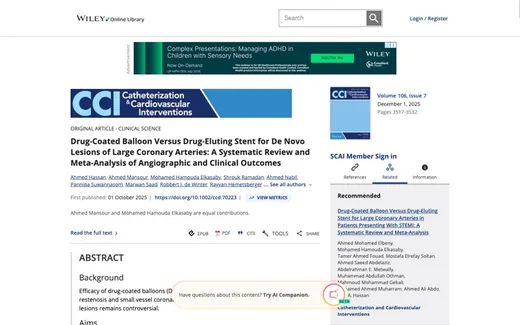
Drug-coated balloon vs drug-eluting stent for de novo lesions of large coronary arteries: a meta-analysis of 9,745 patients
Hassan A, Mansour A, et al. · 2025
Sixteen studies, randomised and observational, pooled with subgroups by design.
View in journal →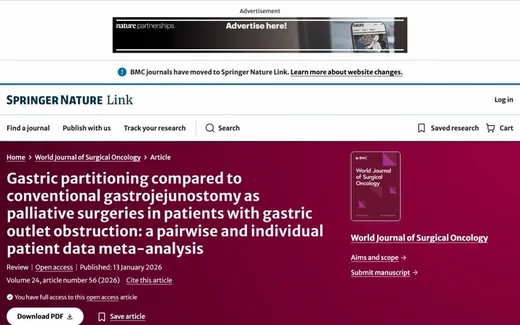
Gastric partitioning vs gastrojejunostomy for gastric outlet obstruction: a pairwise and IPD meta-analysis
Hassan AA, et al. · 2026
Individual-patient-data meta-analysis combining raw patient-level outcomes across studies.
View in journal →
TAVI vs surgical replacement for pure aortic regurgitation: a meta-analysis of 33,484 patients
Cohira team · 2024
Large pairwise meta-analysis comparing transcatheter and surgical valve replacement.
View in journal →These are peer-reviewed papers co-authored by our researchers. A fuller list is available on request.
Pricing
One fee, from idea to publication.
The fee covers
- Protocol, and registration or ethics submission where the design requires it
- Search, dual screening, extraction, and the analysis
- Journal-ready manuscript, figures, and supplements
- Journal shortlist and the full submission package
- Reviewer responses, every round, to a decision
- A named lead and a second internal reviewer
Billed separately
- Journal fees and APCs, at cost
- Database access or licences, at cost
- Optional Acceptance Guarantee, offered at quotation
Per project, never per author. You get the scope, the week-by-week timeline and a fixed fee in writing within two working days, before you pay anything. Discounts & Acceptance Guarantee →
Start a conversation
Have a question worth pooling?
Tell us the comparison you care about. We will tell you honestly whether the literature can support a strong meta-analysis, and how we would build it.