Your clinical question, against 100M+ patient records.
What it is
A live window into routine clinical care.
TriNetX is a global federated network of de-identified electronic health record (EHR) data drawn from more than 120 healthcare organizations, covering well over 100 million patients. It can be queried in real time to count patients, build cohorts, and compare outcomes, the data reflects care as it actually happened, not a controlled trial.
What it is built for
Scale, 100M+ patients across many countries, queried live.
Design, retrospective cohort and propensity-matched comparative effectiveness/safety, with time-to-event analysis.
Limits, coded EHR data; outcomes outside the network may be missed.
How it works
The method, in plain terms.
Define cohorts
Diagnosis, drug, procedure codes
Set time-zero
First prescription or diagnosis
Propensity matching
1:1 balance on covariates
Define outcomes
Mortality, readmission, new diagnoses
Time-to-event
Kaplan-Meier, hazard ratios
Sensitivity checks
Alternative matching, subgroups
How you benefit
Why authors start here.
- Real-world evidence, fast. A matched-cohort study from existing data, no recruitment, no follow-up wait.
- Huge, diverse populations. Rare exposures and outcomes become analyzable across millions of patients.
- Questions trials never answered. Compare real-world treatments and safety signals ethics or cost would never test in an RCT.
- You stay the author. We design and run the study with you to ICMJE standards.
Scope the question
We turn your idea into a clear exposure-vs-comparator question TriNetX can answer.
Protocol & codes
We pre-specify cohorts, index event, outcomes, covariates, and the matching plan.
Build & match cohorts
We construct the groups and run propensity-score matching, checking balance.
Analysis
We run time-to-event and risk analyses, with the sensitivity checks reviewers expect.
Manuscript
We draft a clear paper with you, tables, survival curves, and honest limitations.
Submit & revise
We target the right journal, submit, and answer reviewers with you to a decision.
Published examples
What TriNetX studies look like in print.
Independent, peer-reviewed examples of what this route can produce.

Bidirectional associations between COVID-19 and psychiatric disorder: retrospective cohort studies of 62,354 cases
Taquet M, et al. · 2021
TriNetX cohorts compared against six matched control health events, the design most TriNetX papers in top journals use.
View in journal →
6-month neurological and psychiatric outcomes in 236,379 survivors of COVID-19
Taquet M, et al. · 2021
In 236,379 COVID-19 survivors, a third received a neurological or psychiatric diagnosis within six months, exceeding matched controls.
View in journal →
Panretinal photocoagulation vs anti-VEGF for proliferative diabetic retinopathy
Alsoudi AF, et al. · 2024
Propensity-matched cohorts showed laser-first treatment raised later vitrectomy risk versus anti-VEGF-first.
View in journal →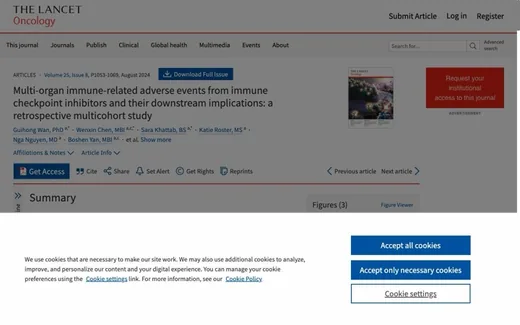
Multi-organ immune-related adverse events from immune checkpoint inhibitors
Wan G, et al. · 2024
A matched cohort showing immune-related adverse-event clusters predict differing survival after checkpoint-inhibitor immunotherapy.
View in journal →We design and publish studies of comparable rigor with you, under your name. The examples above are independent published work, shown to illustrate what TriNetX makes possible.
Pricing
One fee, from idea to publication.
The fee covers
- Protocol, and registration or ethics submission where the design requires it
- Dataset work and the pre-specified analysis
- Journal-ready manuscript, figures, and supplements
- Database access, included in the fee
- Journal shortlist and the full submission package
- Reviewer responses, every round, to a decision
- A named lead and a second internal reviewer
Billed separately
- Journal fees and APCs, at cost
- Optional Acceptance Guarantee, offered at quotation
Per project, never per author. You get the scope, the week-by-week timeline and a fixed fee in writing within two working days, before you pay anything. Discounts & Acceptance Guarantee →
Start a conversation
Have a real-world question to test?
Tell us the treatments or outcomes you want to compare. We will tell you honestly whether TriNetX can support a strong paper, and how we would build it.