Half a million participants, deeply phenotyped.
What it is
The most detailed population cohort in the world.
UK Biobank recruited about 500,000 volunteers aged 40 to 69 across the United Kingdom between 2006 and 2010. Each gave blood, urine, and saliva, completed detailed lifestyle and medical questionnaires, and had physical measurements taken.
What it is built for
Scale, 500,000 participants, genotyped, with 10 to 15+ years of linked follow-up.
Design, prospective exposure-outcome cohorts, Mendelian randomisation, polygenic risk scores, prognostic model development and validation.
Limits, healthier and less diverse than the general population; access approval and platform costs take time and must be planned for.
How it works
The method, in plain terms.
Access
Application, fields, platform
Exposure & outcomes
Baseline data, linked records
Build the cohort
Exclusions, missing data
Cohort analysis
Cox, dose-response
Genetic layers
MR, polygenic scores
Reporting
STROBE / STROBE-MR
How you benefit
Why authors start here.
- Phenotype depth nothing else matches. Genetics, imaging, biomarkers, and lifestyle on the same people.
- Prospective, not retrospective. Exposures measured before outcomes, the design reviewers trust most in observational work.
- Causal questions, credibly. Mendelian randomisation lets you ask whether an exposure causes an outcome, not just whether they travel together.
- You stay the author. We design and run the study with you to ICMJE standards.
Scope the question
We turn your idea into an exposure-outcome, causal, or prognostic question the cohort can answer.
Access plan
We map the application, the fields needed, and the platform steps and costs into a realistic timeline.
Protocol
We pre-specify the cohort, outcomes, covariates, and analysis, including any genetic instruments or scores.
Analysis
Cohort, Mendelian randomisation, or polygenic analyses in R or Python, with the sensitivity checks reviewers expect.
Manuscript
We draft a clear paper with you, figures, tables, and limitations reported to STROBE or STROBE-MR.
Submit & revise
We shortlist the right journals, package the submission, and answer reviewers with you to a decision.
Published examples
What UK Biobank studies look like in print.
Independent, peer-reviewed examples of what this route can produce.
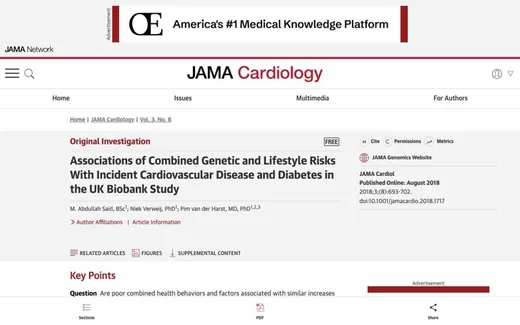
Associations of combined genetic and lifestyle risks with incident cardiovascular disease and diabetes in UK Biobank
Said MA, et al. · 2018
Polygenic risk and lifestyle compared across 339,003 participants, genetics and behaviour in one cohort design.
View in journal →
Alcohol consumption and cardiovascular disease: a Mendelian randomization study in UK Biobank
Larsson SC, et al. · 2020
Genetic instruments used to test whether alcohol causes cardiovascular disease, the causal design UK Biobank enables.
View in journal →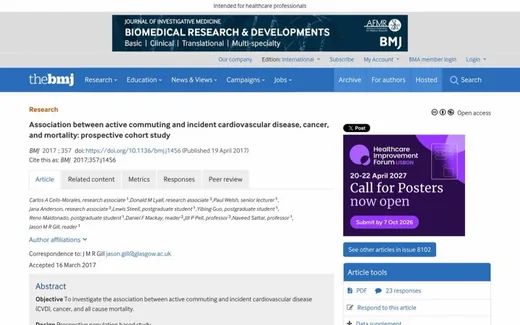
Active commuting and incident cardiovascular disease, cancer, and mortality
Celis-Morales CA, et al. · 2017
A prospective analysis of 263,540 participants linking cycling to work with lower cardiovascular and all-cause mortality.
View in journal →
Genome-wide polygenic scores for common diseases identify individuals at monogenic-equivalent risk
Khera AV, et al. · 2018
Polygenic scores validated in UK Biobank identified people at several-fold risk of coronary disease, atrial fibrillation, and diabetes.
View in journal →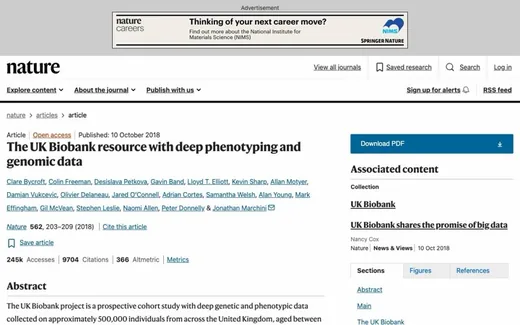
The UK Biobank resource with deep phenotyping and genomic data
Bycroft C, et al. · 2018
The reference description of the cohort, its genotyping, and its linked data, the paper every UK Biobank study cites.
View in journal →These are independent published studies, shown to illustrate what UK Biobank makes possible, they are not Cohira's work. We help you design and publish studies of comparable rigor.
Pricing
One fee, from idea to publication.
The fee covers
- Protocol, and registration or ethics submission where the design requires it
- Dataset work and the pre-specified analysis
- Journal-ready manuscript, figures, and supplements
- Database access, included in the fee
- Journal shortlist and the full submission package
- Reviewer responses, every round, to a decision
- A named lead and a second internal reviewer
Billed separately
- Journal fees and APCs, at cost
- Optional Acceptance Guarantee, offered at quotation
Per project, never per author. You get the scope, the week-by-week timeline and a fixed fee in writing within two working days, before you pay anything. Discounts & Acceptance Guarantee →
Start a conversation
Have an exposure, a gene, or a risk score in mind?
Tell us the question. You will receive a free feasibility note, design, expected sample, access requirements, and realistic target journals, before you commit to anything.