Decades of cancer follow-up, waiting for your question.
What it is
A national cancer registry, patient by patient.
SEER (Surveillance, Epidemiology, and End Results) is the US National Cancer Institute's programme of population-based cancer registries. Since 1975 it has recorded every new cancer in its catchment areas, now close to half of the US population, with demographics, primary site and histology, stage at diagnosis, first-course treatment, and vital status updated every year.
What it is built for
Scale, millions of cancer cases, followed for survival since 1975.
Design, survival and competing-risk analysis, conditional survival, treatment effectiveness in trial-excluded groups, nomogram development and validation.
Limits, no recurrence, comorbidity, or systemic-therapy detail; treatment is coded broadly, so questions are designed around that.
How it works
The method, in plain terms.
Define the cohort
ICD-O-3 site, stage, years
Harmonise staging
Across AJCC editions
Describe
Rates, stage, treatment
Survival
Kaplan-Meier, Cox
Competing risks
Fine-Gray models
Model & validate
Nomograms, calibration
How you benefit
Why authors start here.
- Decades of follow-up, ready now. Survival questions that would take a centre twenty years to answer are already recorded.
- Rare cancers become analysable. Population coverage makes uncommon sites and histologies large enough to study.
- Beyond the trial population. Real-world effectiveness in the elderly, in rare stages, and in groups trials exclude.
- You stay the author. We design and run the study with you to ICMJE standards.
Scope the question
We turn your idea into a survival, competing-risk, or prognostic question SEER can actually answer.
Protocol & codes
We pre-specify the cohort, codes, exclusions, outcomes, covariates, and the modelling plan.
Extract & clean
We pull the extract, harmonise staging across editions, and document every exclusion.
Analysis
Survival, competing-risk, and (where planned) nomogram development with validation, in reproducible R code.
Manuscript
We draft a clear paper with you, tables, survival curves, calibration plots, and honest limitations.
Submit & revise
We shortlist the right journals, package the submission, and answer reviewers with you to a decision.
Published examples
What SEER studies look like in print.
Independent, peer-reviewed examples of what this route can produce.
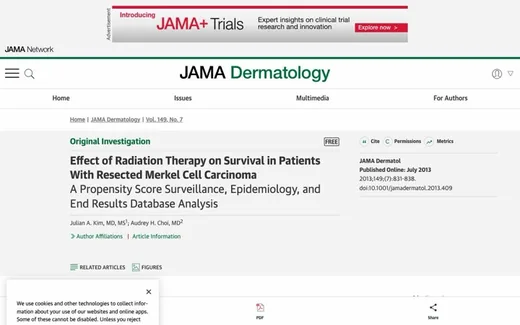
Effect of radiation therapy on survival in patients with resected Merkel cell carcinoma
Mullen JT, et al. · 2013
A SEER comparison of adjuvant radiotherapy versus surgery alone, adjusted for stage and patient factors.
View in journal →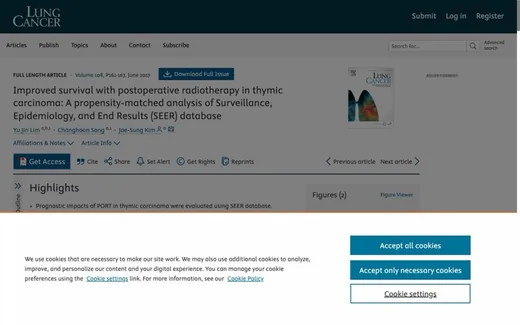
Improved survival with postoperative radiotherapy in thymic carcinoma: a propensity-matched SEER analysis
Lim YJ, et al. · 2017
Propensity-matched SEER cohorts comparing survival with and without radiotherapy, the design a registry supports best.
View in journal →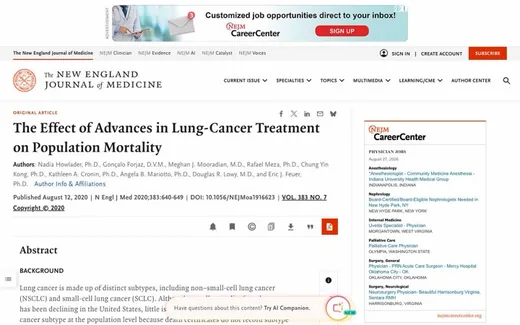
The effect of advances in lung-cancer treatment on population mortality
Howlader N, et al. · 2020
SEER incidence and survival data showed population-level lung-cancer mortality falling faster than incidence as targeted therapies arrived.
View in journal →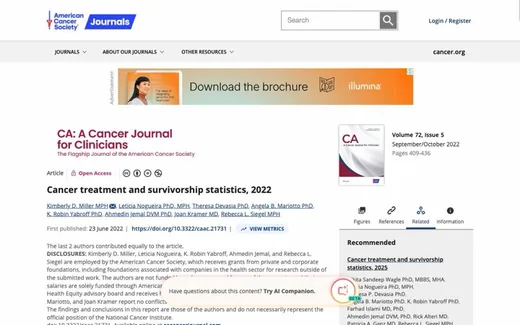
Cancer treatment and survivorship statistics, 2022
Miller KD, et al. · 2022
SEER-based survival and prevalence estimates underpin the most-cited survivorship statistics in oncology.
View in journal →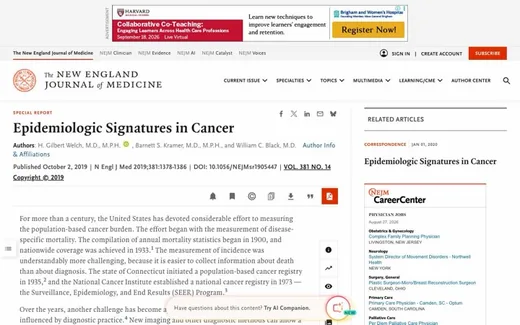
Epidemiologic signatures in cancer
Welch HG, et al. · 2019
Four decades of SEER incidence and mortality trends used to distinguish real changes in cancer burden from overdiagnosis.
View in journal →These are independent published studies, shown to illustrate what SEER makes possible, they are not Cohira's work. We help you design and publish studies of comparable rigor.
Pricing
One fee, from idea to publication.
The fee covers
- Protocol, and registration or ethics submission where the design requires it
- Dataset work and the pre-specified analysis
- Journal-ready manuscript, figures, and supplements
- Database access, included in the fee
- Journal shortlist and the full submission package
- Reviewer responses, every round, to a decision
- A named lead and a second internal reviewer
Billed separately
- Journal fees and APCs, at cost
- Optional Acceptance Guarantee, offered at quotation
Per project, never per author. You get the scope, the week-by-week timeline and a fixed fee in writing within two working days, before you pay anything. Discounts & Acceptance Guarantee →
Start a conversation
Have a cancer outcomes question?
Tell us the cancer, the comparison, or the prognostic tool you have in mind. You will receive a free feasibility note, design, expected sample, and realistic target journals, before you commit to anything.