Prediction models that reviewers can use.
What it is
A model that predicts, and proves it.
A clinical prediction model estimates an individual's risk of an outcome, death, readmission, complication, response, from things known at the point of decision. Machine learning extends the classical logistic or Cox model with algorithms that can capture non-linear patterns and interactions: penalised (LASSO, ridge, elastic-net) regression, random forests, gradient boosting (XGBoost, LightGBM), and neural networks.
What it is built for
Data, your registry or cohort, or NIS, TriNetX, SEER, UK Biobank, and similar sources.
Methods, regularised regression, random forest, gradient boosting, neural networks; tuning, internal/external validation, calibration, decision curve analysis, SHAP.
Deliverables. TRIPOD / TRIPOD+AI manuscript and a working web calculator.
How it works
The method, in plain terms.
Frame the task
Outcome, horizon, predictors
Prepare data
Leakage-safe split
Train & tune
Regression to boosting
Validate
AUC and calibration
Utility
Decision curves, SHAP
Report & deploy
TRIPOD+AI, web calculator
How you benefit
Why authors start here.
- Higher-impact journals, faster. Well-validated AI/ML models are currently among the most sought-after study types in clinical journals.
- Your data, working harder. A registry or cohort you already hold can become a prognostic tool, not just a descriptive paper.
- Built to pass PROBAST. Sample size, validation, and calibration handled the way methodological reviewers check for.
- You stay the author. We build and validate the model with you to ICMJE standards.
Scope the model
We agree the outcome, the setting, the predictors available at decision time, and whether your data or a large database is the right source.
Protocol & sample size
We pre-specify the pipeline and check the data can support the number of predictors without overfitting.
Develop
We train and tune candidate algorithms in reproducible Python or R code, with a transparent baseline model for comparison.
Validate & explain
Internal and external validation, calibration, decision curve analysis, and SHAP interpretation.
Manuscript & calculator
We draft the TRIPOD+AI paper with you and build the web calculator that accompanies it.
Submit & revise
We shortlist the right journals, package the submission, and answer reviewers with you to a decision.
Published examples & standards
What prediction-model work looks like in print.
Independent, peer-reviewed examples of what this route can produce.
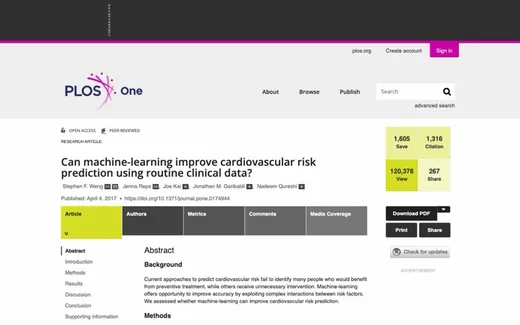
Can machine learning improve cardiovascular risk prediction using routine clinical data?
Weng SF, et al. · 2017
Four machine-learning algorithms compared head-to-head with the ACC/AHA risk score in 378,256 patients.
View in journal →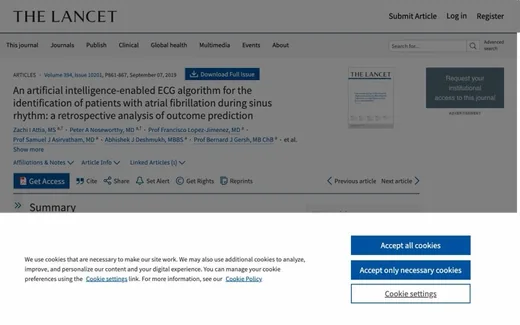
An AI-enabled ECG algorithm for identifying patients with atrial fibrillation during sinus rhythm
Attia ZI, et al. · 2019
A neural network trained on 649,931 ECGs and validated on a held-out set, development and validation done properly.
View in journal →
Cardiovascular event prediction by machine learning
Ambale-Venkatesh B, et al. · 2017
Random survival forests on imaging, biomarker, and clinical data from a multi-ethnic cohort outperformed established risk scores.
View in journal →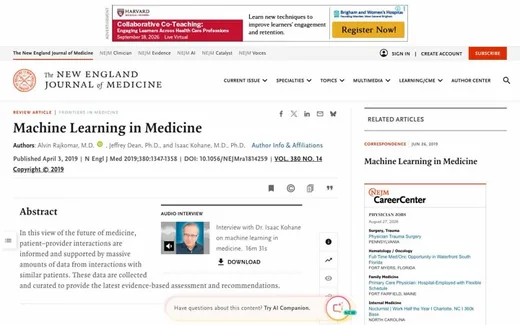
Machine learning in medicine
Rajkomar A, Dean J, Kohane I · 2019
The reference overview of what machine learning can and cannot do in clinical prediction, and the pitfalls reviewers look for.
View in journal →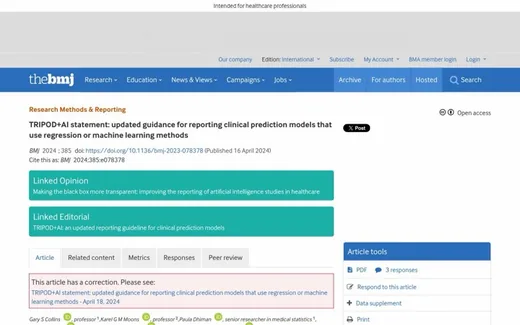
TRIPOD+AI statement: updated guidance for reporting clinical prediction models
Collins GS, et al. · 2024
The checklist journals now expect for regression and machine-learning prediction models, every Cohira model is written to it.
View in journal →These are independent publications, shown to illustrate the field and its standards, they are not Cohira's work. We help you develop and publish models of comparable rigor.
Pricing
One fee, from idea to publication.
The fee covers
- Protocol, and registration or ethics submission where the design requires it
- Dataset work and the pre-specified analysis
- Journal-ready manuscript, figures, and supplements
- Journal shortlist and the full submission package
- Reviewer responses, every round, to a decision
- A named lead and a second internal reviewer
Billed separately
- Journal fees and APCs, at cost
- Database access or licences, at cost
- Optional Acceptance Guarantee, offered at quotation
Per project, never per author. You get the scope, the week-by-week timeline and a fixed fee in writing within two working days, before you pay anything. Discounts & Acceptance Guarantee →
Start a conversation
Have an outcome worth predicting?
Tell us the outcome and the data you hold or want to use. You will receive a free feasibility note, design, expected sample, and realistic target journals, before you commit to anything.