NIS & real-world data.
What it is
Millions of real admissions, one national picture.
The National Inpatient Sample (NIS), part of the AHRQ Healthcare Cost and Utilization Project (HCUP), is the largest publicly available all-payer inpatient care database in the US. It is a stratified ~20% sample of discharges from community hospitals, weighted to represent more than 35 million hospitalizations a year, each coded with ICD diagnoses and procedures.
What it can and cannot do
Strength, national, representative estimates from millions of admissions.
Design, retrospective cross-sectional and trend (serial cross-sectional) analyses.
Limits, it counts encounters, not unique patients, and has no post-discharge follow-up.
How it works
The method, in plain terms.
Define the cohort
ICD-10-CM/PCS codes
Survey weights
20% sample → national estimates
Outcomes & covariates
Mortality, LOS, cost, comorbidity
Trends
Joinpoint across years
Risk adjustment
Multivariable, propensity
Reporting
HCUP rules, honest caveats
How you benefit
Why authors start here.
- Enormous statistical power. Millions of admissions make even rare outcomes and small subgroups analyzable.
- No recruitment, no follow-up. The data already exists, a publishable study without patients or years of waiting.
- National, generalizable findings. Representative estimates that editors and guideline groups take seriously.
- You stay the author. We run the analysis with you to ICMJE standards; the work is yours to defend.
Scope the question
We refine your idea into a national question NIS can actually answer, and confirm the codes exist.
Cohort & codes
We define the ICD-based cohort, comparators, outcomes, and covariates in a pre-specified plan.
Data & weighting
We obtain the relevant NIS years and apply the correct survey weights and design.
Analysis
We run weighted, risk-adjusted analyses in R or Stata, with trend and sensitivity checks.
Manuscript
We draft a clear paper with you, tables, trend figures, and an honest limitations section.
Submit & revise
We target the right journal, submit, and answer reviewers with you through to a decision.
Published examples
What NIS studies look like in print.
Independent, peer-reviewed examples of what this route can produce.

Trends in incidence, management, and outcomes of cardiogenic shock complicating STEMI in the United States
Kolte D, et al. · 2014
NIS analysis comparing outcomes across years and treatment strategies in 1.99 million STEMI hospitalisations.
View in journal →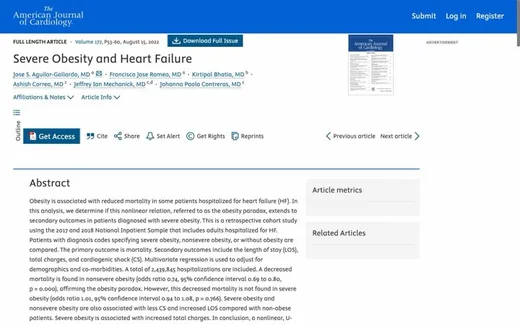
Severe obesity and heart failure
Aguilar-Gallardo JS, et al. · 2022
Across 2.4 million heart-failure admissions, the obesity-survival paradox held for non-severe but not severe obesity.
View in journal →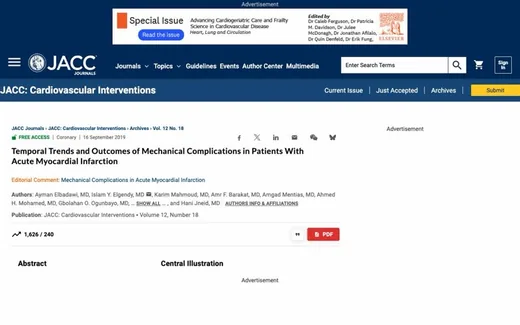
Temporal trends and outcomes of mechanical complications in acute myocardial infarction
Elbadawi A, et al. · 2019
Analyzed ~9 million MI hospitalizations; mechanical complications were rare but carried roughly 42% mortality after STEMI.
View in journal →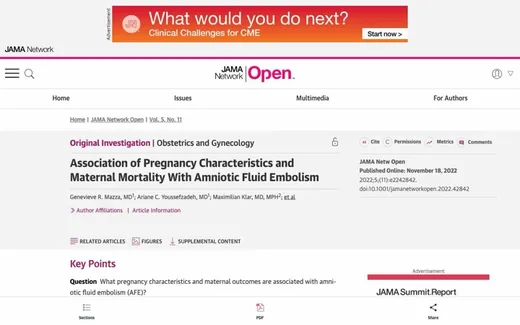
Pregnancy characteristics and maternal mortality with amniotic fluid embolism
Mazza GR, et al. · 2022
Among 14.7 million deliveries, characterized amniotic fluid embolism risk factors and its 17% failure-to-rescue mortality.
View in journal →These are independent published studies, shown to illustrate what the NIS makes possible, they are not Cohira's work. We help you design and publish studies of comparable rigor.
Pricing
One fee, from idea to publication.
The fee covers
- Protocol, and registration or ethics submission where the design requires it
- Dataset work and the pre-specified analysis
- Journal-ready manuscript, figures, and supplements
- Database access, included in the fee
- Journal shortlist and the full submission package
- Reviewer responses, every round, to a decision
- A named lead and a second internal reviewer
Billed separately
- Journal fees and APCs, at cost
- Optional Acceptance Guarantee, offered at quotation
Per project, never per author. Scope and timeline are fixed in the free feasibility note before you pay. Discounts & Acceptance Guarantee →
Start a conversation
Have a national question to answer?
Tell us the outcome or trend you care about. We will tell you honestly whether NIS can support a strong paper, and how we would build it.