Readmissions, nationally.
What it is
The database built for the readmission question.
The Nationwide Readmissions Database (NRD), part of AHRQ's Healthcare Cost and Utilization Project, links roughly 17 million discharges a year across hospitals within a state, so a patient's return admission is captured wherever it happens. It is the standard source for national 30- and 90-day readmission studies, the outcome that hospitals, payers, and journals care about most.
What it is built for
Scale, ~17 million weighted discharges a year, linked within the calendar year.
Design, readmission rates, causes, predictors, costs, and trends after any index diagnosis or procedure; comparisons between treatments or patient groups.
Limits, no linkage across calendar years or states; no post-discharge mortality; coded data only.
How it works
The method, in plain terms.
Index admission
Diagnosis or procedure codes
Link readmissions
Patient linkage within the year
30-day window
Or 90-day; calendar rules
Causes
Primary diagnosis at readmission
Predictors
Multivariable, survey-weighted
Costs & trends
Charges, LOS, year-on-year
How you benefit
Why authors start here.
- An outcome everyone cares about. Readmission is a quality metric, a cost driver, and a policy target.
- Any condition or procedure. If it is coded, its readmissions can be studied.
- Weeks, not years. The data exists; no recruitment, no follow-up.
- You stay the author. We design and run the study with you to ICMJE standards.
Scope the question
We turn your idea into an index event, a readmission window, and a comparison NRD can answer.
Protocol & codes
Index codes, exclusions, outcomes, covariates, and the weighting plan, pre-specified.
Build the cohort
Index admissions linked to their readmissions, with the calendar-year rules applied honestly.
Analysis
Rates, causes, predictors, costs, and trends, with the checks reviewers expect.
Manuscript
Drafted with you to RECORD/STROBE and formatted to the target journal.
Submit & revise
Journal shortlist, submission package, and reviewer responses to a decision.
Published examples
What NRD studies look like in print.
Independent, peer-reviewed examples of what this route can produce.
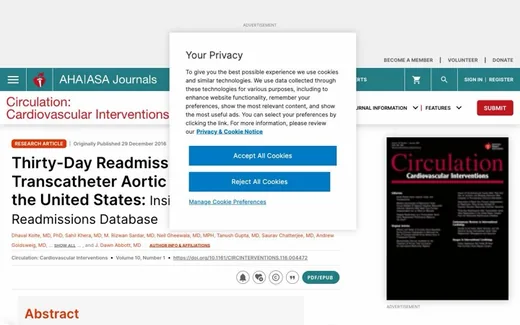
Thirty-day readmissions after transcatheter aortic valve replacement in the United States
Kolte D, et al. · 2017
NRD analysis comparing readmission rates, causes, and costs across patient groups after TAVR.
View in journal →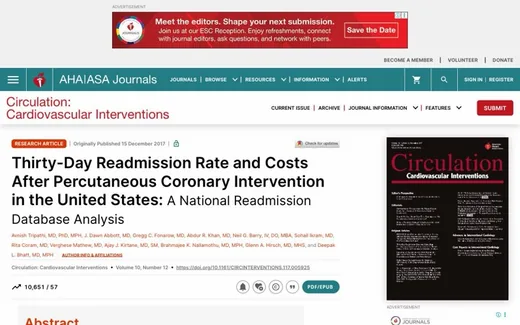
Thirty-day readmission rate and costs after percutaneous coronary intervention in the United States
Tripathi A, et al. · 2017
Readmission rates and predictors compared across PCI indications and patient characteristics.
View in journal →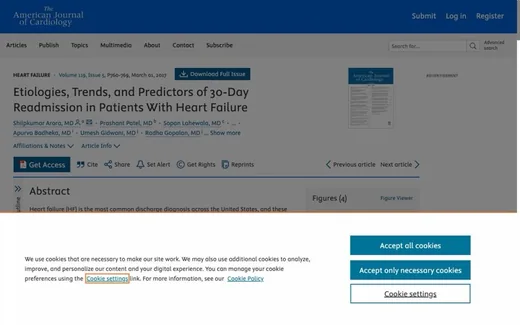
Etiologies, trends, and predictors of 30-day readmission in patients with heart failure
Arora S, et al. · 2017
Causes and predictors of heart-failure readmission compared across years and subgroups.
View in journal →These are independent published studies, shown to illustrate the route, they are not Cohira's work.
Pricing
One fee, from idea to publication.
The fee covers
- Protocol, and registration or ethics submission where the design requires it
- Dataset work and the pre-specified analysis
- Journal-ready manuscript, figures, and supplements
- Database access, included in the fee
- Journal shortlist and the full submission package
- Reviewer responses, every round, to a decision
- A named lead and a second internal reviewer
Billed separately
- Journal fees and APCs, at cost
- Optional Acceptance Guarantee, offered at quotation
Per project, never per author. Scope and timeline are fixed in the free feasibility note before you pay. Discounts & Acceptance Guarantee →
Start a conversation
Have a readmission question?
Tell us the index condition or procedure. You get a free feasibility note, design, expected sample, and realistic journals, before you commit.